
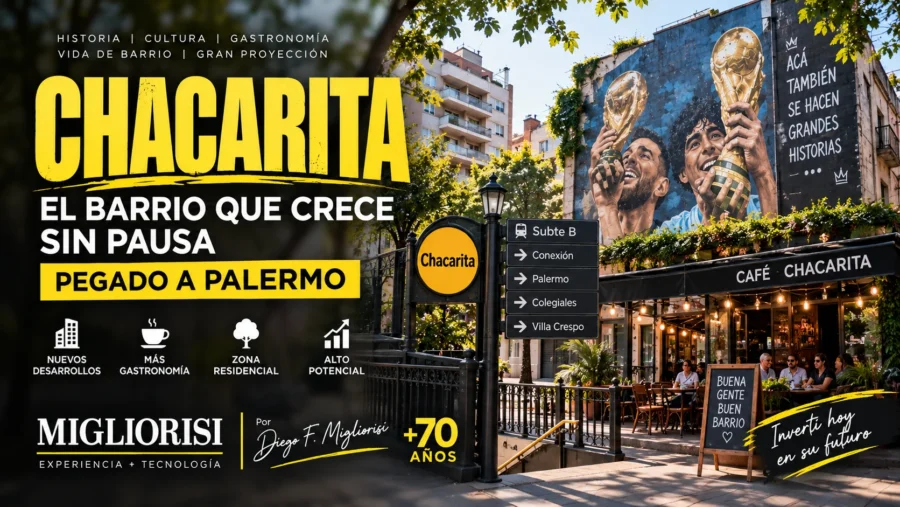
Valor del M2 en Chacarita 2027: por qué sigue subiendo

Por Diego Migliorisi
El valor del m2 en Chacarita viene subiendo de forma sostenida desde hace un par de años, y no por moda pasajera: es estructural. Palermo llegó a un techo —no de prestigio, sino de algo más terrenal: ya no hay dónde construir, y lo poco que queda se paga carísimo—. Eso genera un efecto que conozco de memoria después de tantos años en esto: cuando un barrio se satura, el que se beneficia es el de al lado. Hoy ese barrio es Chacarita, y lo digo sin especular: lo vengo viendo operación tras operación.
Para mí es el barrio con mayor proyección de toda la Ciudad en este momento. El m2 ahí todavía cuesta sensiblemente menos que en Palermo, pero la brecha se achica mes a mes.
Cuánto vale el m2 en Chacarita hoy
La ubicación ayuda de una manera bastante concreta: subte, metrobús, varias líneas de colectivo, la estación de trenes, y algo que sigo remarcando cada vez que hablo del barrio: todavía se consigue estacionar en la calle sin pelear una cuadra por lugar, algo que en Palermo o Villa Crespo ya es casi anécdota del pasado.
El barrio, además, no es homogéneo, y ahí está buena parte de su gracia. Sobre Dorrego y Jorge Newbery está la zona que más rápido se está transformando: edificios nuevos, pozos en marcha, la fisonomía cambiando manzana a manzana. Un poco más adentro hay un polo gastronómico que ya tiene identidad propia —cantinas reversionadas, bares de autor, restaurantes chicos con productor detrás— y que le da vida al barrio entre semana, no solo los fines de semana.
Chacarita barrio ingles
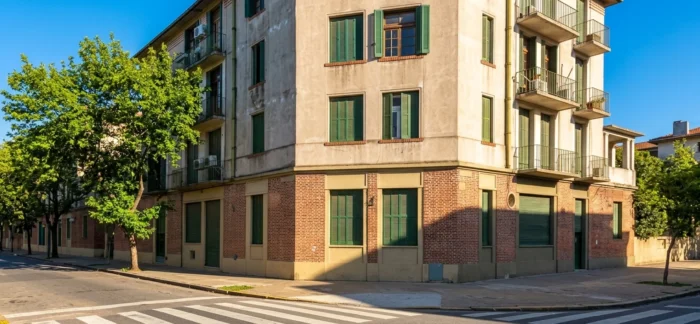
Y después está el otro Chacarita, el que casi no se ve desde afuera: el Barrio Inglés y varias manzanas residenciales donde la altura está limitada por normativa. Ahí pongo el foco cuando alguien me consulta por algo más que rentabilidad rápida: comprar un PH o una casa baja en esas zonas es comprar con la garantía de que dentro de cinco años nadie te va a tapar el sol con una torre de siete pisos. Esa convivencia entre una zona en plena transformación y manzanas protegidas de la edificación en altura es poco común en Buenos Aires, y es, en el fondo, lo que sostiene la suba del valor del m2 en Chacarita a mediano plazo, no solo el efecto derrame de Palermo.
Mi lectura es simple: Villa Crespo y Colegiales ya capitalizaron buena parte de ese desborde y hoy están bastante más caros que hace tres años. Chacarita todavía no, y ese es exactamente el margen que hoy lo hace atractivo, tanto para quien busca vivir ahí como para quien piensa en inversión.
OPcion Paternal
Mercado inmobiliario 2027: Qué pasa en Paternal
Chacarita: the Buenos Aires Neighborhood Stealing the Spotlight from Palermo
By Diego Migliorisi
Palermo has hit a ceiling. Not in prestige — it’s still the strongest brand in the Buenos Aires market — but in something more concrete: there’s simply nowhere left to build, and what little land remains sells at a premium. That triggers an effect I’ve seen play out for years in this business: when one neighborhood saturates, the one next door benefits. Right now, that neighborhood is Chacarita, and I’m not speculating — I’ve watched it happen deal after deal.
To me, it’s the neighborhood with the strongest growth potential in the whole city right now. Price per square meter there is still noticeably lower than in Palermo, but it’s been climbing steadily for a couple of years now, and it’s not a passing trend — it’s structural. Location, transport, and a supply of land Palermo simply doesn’t have anymore.
Why I see it this way
Location helps in a very concrete way: subway, the Metrobus line, several bus routes, the train station, and something I keep pointing out whenever I talk about this neighborhood — you can still find street parking without circling the block, which in Palermo or Villa Crespo is practically a thing of the past.
The neighborhood also isn’t uniform, and that’s a big part of its appeal. Along Dorrego and Jorge Newbery is where things are changing fastest: new buildings, projects underway, the streetscape shifting block by block. A bit further in, there’s a dining and nightlife scene with its own identity now — reimagined cantinas, design-forward bars, small restaurants with real chefs behind them — giving the neighborhood life on weeknights, not just weekends.
And then there’s the other Chacarita, the one you don’t see from the outside: the Barrio Inglés and several residential blocks where height limits are written into local zoning. That’s where I point people who are after something more than quick returns: buying a PH or a low-rise house in those blocks means buying with the guarantee that five years from now, nobody’s putting up a seven-story building that blocks your sunlight. That mix — a neighborhood in the middle of transformation sitting right next to blocks protected from high-rise development — is rare in Buenos Aires, and it’s really what sustains price growth over the medium term, not just Palermo’s spillover.
My read is simple: Villa Crespo and Colegiales have already captured most of that spillover and are considerably more expensive than they were three years ago. Chacarita hasn’t yet, and that gap is exactly what makes it attractive right now — whether you’re looking to live there or to invest.
Valor del M2 en Chacarita 2027: por qué sigue subiendo.Valor del M2 en Chacarita.Valor del M2 en Chacarita.Valor del M2 en Chacarita.Valor del M2 en Chacarita 2027: por qué sigue subiendo.Valor del M2 en Chacarita.Valor del M2 en Chacarita.Valor del M2 en Chacarita.Valor del M2 en Chacarita 2027: por qué sigue subiendo.Valor del M2 en Chacarita.Valor del M2 en Chacarita.Valor del M2 en Chacarita.